
Causes
Ceiling Water Damage From a Roof Leak
Short answer
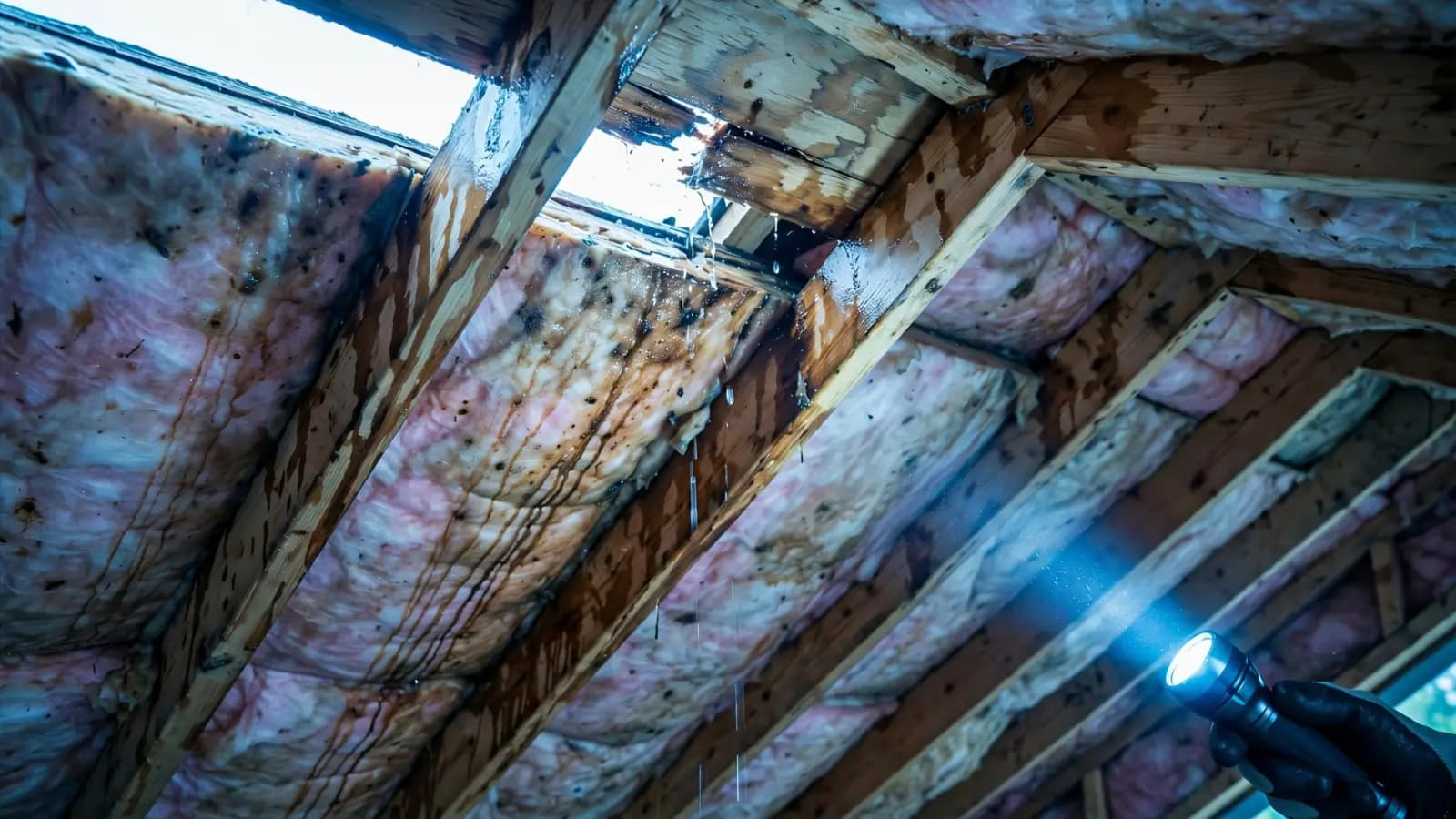
A roof leak damages the ceiling when rain gets past the shingles or flashing, runs along the roof deck and rafters, soaks the attic insulation and then the top of the drywall. Because water travels downhill before dripping, the stain often appears several feet from the actual roof opening. The roof needs a roofer; the ceiling needs drying and repair afterward.
At a glance
- Condition
- Rainwater entering through the roof assembly and reaching top-floor ceilings.
- Common causes
- Failed flashing at chimneys, walls and skylights; cracked pipe boots; missing or lifted shingles; ice dams; clogged valleys and gutters.
- Evidence
- Stains that appear or grow after rain, damp insulation, water marks on rafters and the underside of the roof deck.
- Risk if ignored
- Repeated wetting causes rot in roof sheathing, mold in insulation, and ceiling saturation during heavy storms.
- What to do now
- Contain drips, photograph after each rain, inspect the attic during rain if it is safe to do so.
- Solution
- Roof repair by a roofer, then drying of insulation and framing, and ceiling repair.
How roof water reaches the ceiling
Water that gets under a shingle or past a flashing lands on the roof sheathing or underlayment and runs downhill. It may follow the deck to a rafter, run along the rafter, drip onto the insulation, and spread across the top of the drywall until it finds a seam, a fastener, a light fixture box or a low point. That path is why a leak at a chimney can show up as a stain in the middle of a bedroom ceiling.
How water travels through a ceiling
Where roofs leak most often
| Roof component | How it fails | Where the ceiling stain tends to show |
|---|---|---|
| Plumbing vent pipe boot | Rubber collar cracks with age and sun | Near bathrooms or the center of the house |
| Chimney flashing | Step or counter-flashing separates, sealant fails | Ceiling or wall next to the chimney |
| Skylight | Flashing or seal failure, condensation | Around the skylight well |
| Valleys | Debris dams water, shingles wear | Below where two roof planes meet |
| Wall-to-roof joints | Missing kick-out flashing | Ceiling and wall below the joint |
| Shingles | Missing, lifted or cracked after wind | Anywhere; often random spots after storms |
| Eaves in cold climates | Ice dams push water under shingles | Near exterior walls |
How to confirm it is the roof
- The stain grows or the drip starts only during or after rain.
- Wind-driven rain from one direction makes it worse, which points to flashing or siding at the roof line.
- In the attic, look for water trails on the underside of the roof deck, darkened rafters, rusty nail tips, and compressed or stained insulation.
- In winter, ice dams at the eaves with stains along exterior walls point to ice-dam leaks rather than holes in the roof.
Protecting the ceiling until the roof is repaired
- Put containers under drips and plastic over belongings.
- From the attic, catch drips with a container on a board laid across joists, if it is safe to reach.
- Pull back wet insulation where water is landing so the drywall can dry.
- Ask the roofer for an emergency tarp if a permanent repair cannot happen before the next rain.
- Track rain events and stain size with dated photos.
After the roof is fixed
Repeated wetting from a slow roof leak often leaves wet insulation, damp rafters and stained or weakened drywall. The insulation is usually replaced where it was soaked. The drywall is dried and repaired if it is firm, or replaced if it is soft or sagging. See drying a water-damaged ceiling and ceiling water damage repair. Storm-related roof damage is covered under storm damage.
Frequently asked questions
Why does my ceiling leak when it rains?
Rain is getting through the roof or flashing, or through a wall or window above that ceiling. The most common failure points are pipe vent boots, chimney and wall flashing, skylights, valleys and damaged shingles.
Why is the ceiling leak not directly under the roof damage?
Water runs down the roof deck and along rafters before it drips onto the insulation and drywall. It shows up wherever it finds a low point or opening, which can be several feet away.
Should I call a roofer or a water damage company?
Both, in that order. A roofer stops the water; a restoration company dries the insulation, framing and ceiling. If the ceiling is sagging, call the restoration company immediately as well.
Can a roof leak cause the ceiling to collapse?
Yes, during heavy rain a large leak can saturate the drywall and insulation above it until the ceiling sags and fails. Slow leaks are more likely to cause rot and mold over time.
What is an ice dam leak?
In cold climates, snow on a warm roof melts, runs down, and refreezes at the colder eaves, forming a ridge of ice. Water then backs up behind it and under the shingles, leaking into the attic and ceilings near exterior walls.
Related guides
- CausesStorm damageWind-driven rain, fallen trees, hail and hurricanes: ceiling leaks after severe weather.
- Ceiling ProblemsBrown water stainWhat brown or yellow rings mean, how to tell if the leak is still active, and when a stain is only cosmetic.
- Guides & ToolsLeak source finderA step-by-step decision tree for narrowing down where the water comes from.
- ServicesCeiling water damage repairEnd-to-end professional repair: inspection, drying, removal, rebuild and finishing.
Also referenced in
This guide is general educational information, not a site-specific inspection. Read our editorial policy for how content is researched and reviewed.