
Ceiling Problems
Sagging Ceiling From Water Damage
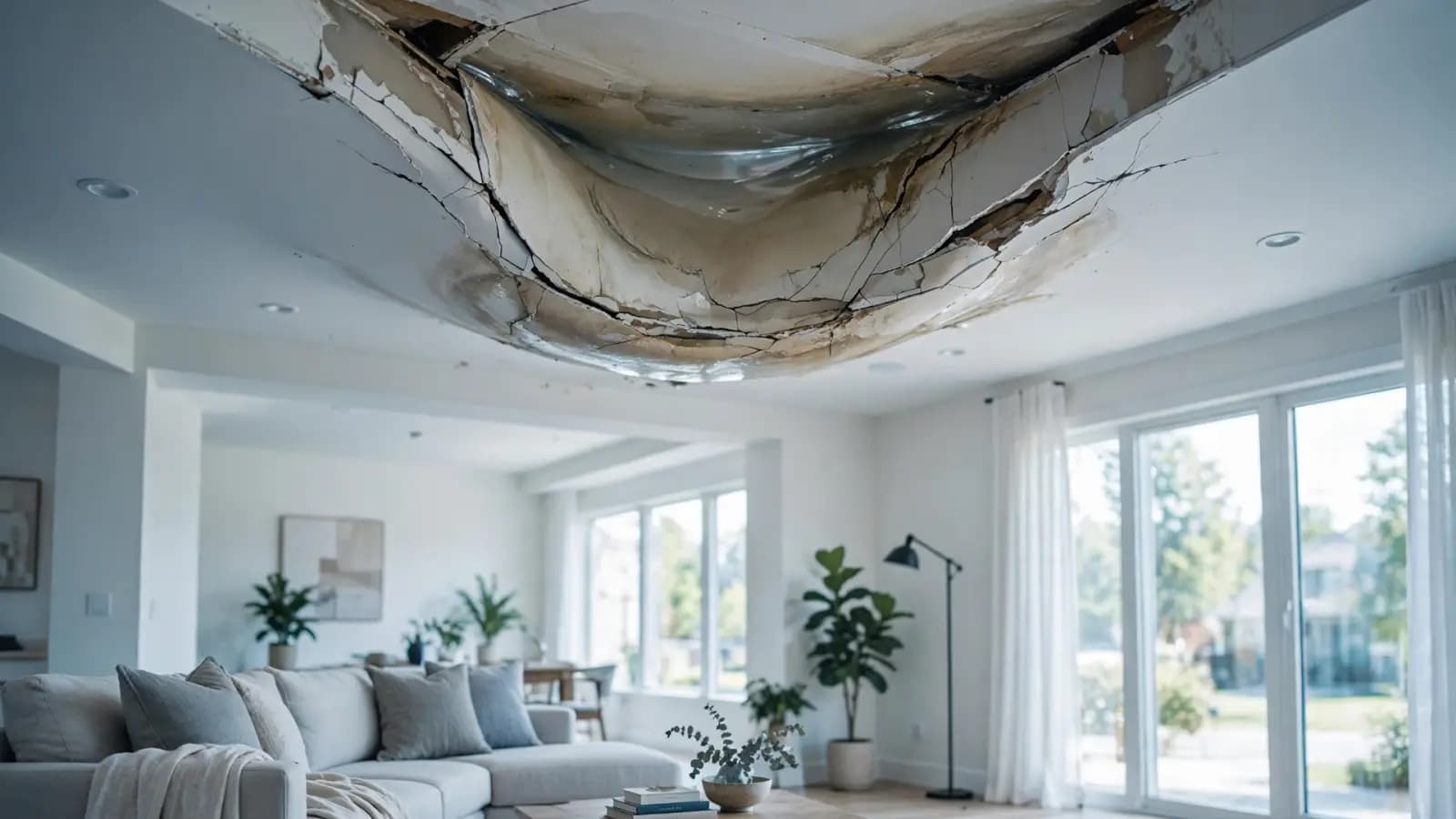
Short answer
A sagging drywall ceiling can indicate that water has saturated the gypsum core, increasing its weight and reducing its strength. Treat it as urgent: keep people and pets out from under it, stop the water source, and switch off power to fixtures in that ceiling if you can do so from a dry location. Sagging drywall almost always needs to be replaced rather than dried in place.
At a glance
- Condition
- Drywall bowing downward between or across framing, sometimes forming a water-filled bulge.
- Common causes
- Large or long-running leaks, overflows from above, roof leaks during heavy rain, and condensate overflow.
- Evidence
- Visible droop, cracks along tape seams, popped screws or nails, a bulge in the paint, water dripping from the low point.
- Risk if ignored
- Wet gypsum is weak and heavy; sagging sections can tear away from fasteners and fall, along with wet insulation and water.
- What to do now
- Clear the area, stop the source, cut power to fixtures in that ceiling if safe, and call for help.
- Solution
- Controlled removal of the sagged section, drying of the cavity and framing, then new drywall.
Why water makes a ceiling sag
Gypsum board gets its strength from a rigid gypsum core bonded to paper faces. Water softens the core and weakens the bond, so a board that easily spans 16 or 24 inches between joists when dry starts to bend under its own weight when wet. At the same time it gets heavier: water weighs about 8.3 pounds per gallon, and soaked insulation lying on the drywall adds more.
Fasteners hold the board at the framing, so the sag forms between joists first. As the paper around screws softens, the board can pull over the screw heads entirely. That is the moment a ceiling section drops.
Sag versus water bubble
A paint bubble forms when water collects between the paint film and the drywall. It can hold a surprising amount of water but the drywall behind it may still be relatively intact. A true sag means the drywall itself is bending. In practice they often happen together: water pools on the drywall, soaks through, and the paint balloons below. Either one means there is standing water in or on the ceiling right now. See bubbling ceiling paint for bubbles without sag.
Ceiling damage severity
- 1Cosmetic stainDry and firm. Seal and repaint once the source is fixed.
- 2Damp materialFresh stain, firm board. Stop the source and dry it.
- 3Saturated drywallSoft spots, bubbling, seam cracks. Professional assessment.
- 4Sagging or bulgingClear the room. Controlled removal needed.
- 5Collapse or contaminationKeep out. Professional cleanup and electrical check.
Full chart: ceiling damage severity chart
Warning signs that collapse may be close
- The sag is getting deeper over minutes or hours.
- Cracking or creaking sounds from the ceiling.
- Tape seams splitting open or screw heads showing through as dimples or tears.
- Water running from a seam or from around a light fixture.
- The droop spans more than one joist bay.
What to do before a contractor arrives
- Move everyone, including pets, out of the room and close the door.
- Stop the water: shut off the fixture or the main water valve, or tarp the roof only if it can be done from the ground or by a professional.
- If the sag is near a light, fan or smoke detector, switch off that circuit at the breaker, but only if the panel area is dry and you are standing on a dry surface.
- If it is safe to enter, move furniture out from under the sag and lay down plastic and towels.
- Photograph the ceiling for documentation.
- Call a water damage restoration company for controlled removal and drying.
Should you puncture a water bubble?
Restoration professionals sometimes drain a contained paint bubble through a small hole to relieve weight, but this is a judgment call that depends on how much water is there, whether the drywall is sagging, and whether wiring or fixtures are nearby. Draining a bulge in drywall that is already sagging can release water and debris suddenly. If you are unsure, do not do it; keep the area clear and let a professional handle it.
Can sagging drywall be saved?
Rarely. Drywall that has deformed usually does not return to flat when it dries, and the paper bond to the core is often damaged. Insulation above is usually soaked too. The standard repair is to cut out the affected section back to sound framing, dry the cavity and joists, replace insulation, and install new board. See when to replace ceiling drywall and drywall ceiling repair.
Frequently asked questions
Can a sagging ceiling collapse?
Yes. Saturated drywall loses much of its strength and can pull over its fasteners and fall, often together with wet insulation and pooled water. The risk rises if the sag is growing, spans several joists, or is cracking at seams. Keep everyone out from under it.
How much water does it take to make drywall sag?
There is no single amount; it depends on board thickness, joist spacing, how long it stays wet and whether water pools on top. A slow leak over days can cause sagging as readily as a sudden overflow, because the core weakens with time as well as with volume.
Can sagging drywall dry back to normal?
Generally no. Even if the board dries, it usually stays deformed and the paper-to-gypsum bond is weakened. Sagged sections are normally replaced.
Does sagging drywall have to be replaced?
In most cases, yes. Drying in place is realistic for damp, flat drywall, not for board that has bent, softened or pulled away from screws.
Who should I call for a sagging ceiling?
Call a water damage restoration company for the ceiling, plus the trade that matches the source: a plumber for a pipe or fixture, a roofer for a roof leak, or an HVAC technician for a condensate overflow. If water is near electrical fixtures, an electrician should check the circuit before it is turned back on.
Is it safe to stay in the house with a sagging ceiling?
Usually yes, as long as everyone stays out of the affected room and the electrical risk is controlled. The hazard is localized under the sag.
Related guides
- EmergencyEmergencyActive leaks, bulging ceilings and water near lights: the safe sequence of steps.
- Guides & ToolsCan it collapse?Why saturated ceilings fail, the warning signs that come first, and safe next steps.
- Repair & DryingRepair or replaceDecision rules for keeping or replacing wet drywall, plus an interactive checker.
- ServicesCeiling water damage repairEnd-to-end professional repair: inspection, drying, removal, rebuild and finishing.
Also referenced in
This guide is general educational information, not a site-specific inspection. Read our editorial policy for how content is researched and reviewed.
Concerned about a sagging ceiling?
Sagging drywall needs controlled removal and drying, not paint. Call now to get it assessed.