
Service guide
Ceiling Leak Detection
Short answer
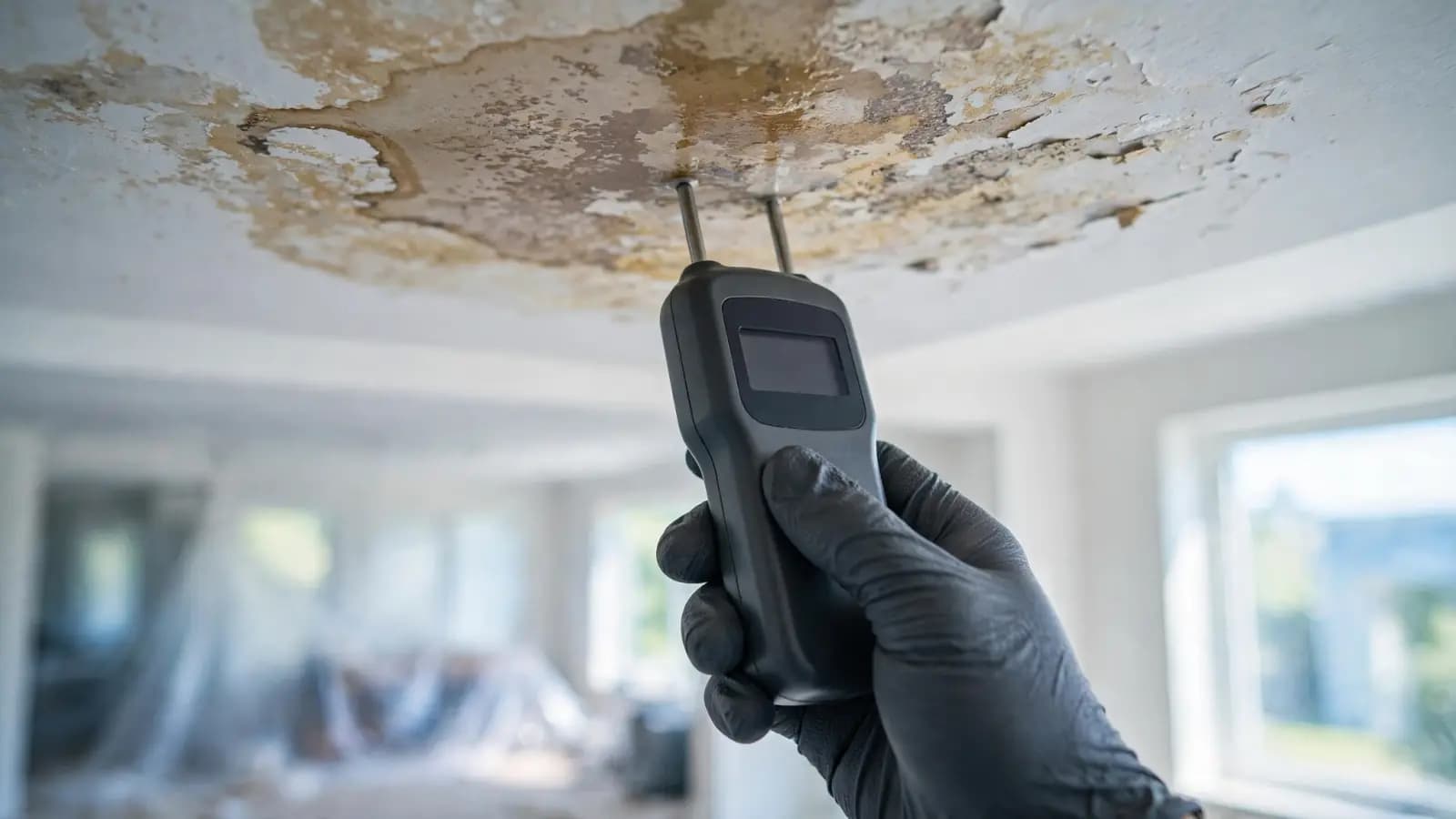
Ceiling leak detection uses non-invasive tools such as moisture meters, thermal imaging cameras and acoustic listening equipment, plus controlled water tests, to find where water is entering before the ceiling is opened. The goal is to cut one small access hole in the right place instead of several exploratory ones.
At a glance
- Condition
- A ceiling leak whose source is not obvious.
- Common causes
- Hidden supply leaks, drain seals, roof and flashing leaks, condensation.
- Evidence
- Stains that recur, wet areas without a clear path, rising water bills.
- Risk if ignored
- Ongoing hidden damage and mold while the source is unknown.
- What to do now
- Run the basic homeowner checks, then bring in detection if unresolved.
- Solution
- Moisture mapping, thermal imaging, acoustic or pressure testing, targeted access.
Tools and what they show
| Tool | What it does | Limits |
|---|---|---|
| Moisture meter (pin or pinless) | Measures moisture in drywall and wood | Point readings; needs a dry reference for comparison |
| Thermal imaging camera | Shows temperature differences that often indicate evaporating moisture | Shows temperature, not water; must be confirmed with a meter |
| Acoustic leak detection | Listens for pressurized water escaping | Supply lines only; noisy environments interfere |
| Pressure test | Isolates and pressurizes a line to see if it holds | Requires plumbing access |
| Water testing | Wets one component at a time (shower, roof section) | Takes time; must be controlled to avoid more damage |
What to try before calling
The ceiling leak source finder covers the homeowner tests: rain correlation, the water meter test, fixture-by-fixture testing and AC season. If those point clearly to one source, call that trade directly. If they do not, detection is worth it.
Who does leak detection
Once found, the leak is repaired by the relevant trade and the ceiling is dried and repaired: ceiling water damage repair.
- Plumbers with acoustic and pressure-test equipment for supply and drain leaks.
- Roofers for roof and flashing leaks, sometimes with controlled water testing.
- Water damage restoration companies for moisture mapping and thermal imaging of the affected area.
- Specialist leak detection companies in some markets.
Frequently asked questions
How do professionals find a leak in the ceiling?
They map moisture with meters, use thermal cameras to spot cooler wet areas, listen for pressurized leaks with acoustic equipment, pressure-test lines, and run controlled water tests on fixtures or roof sections.
Can thermal imaging see water in a ceiling?
It shows temperature differences, and wet areas are often cooler because of evaporation. That makes it a good screening tool, but readings must be confirmed with a moisture meter.
Will leak detection require cutting the ceiling?
Usually only a small, targeted opening for the repair once the source is located, rather than several exploratory holes.
Related guides
- Guides & ToolsLeak source finderA step-by-step decision tree for narrowing down where the water comes from.
- CausesPlumbing leakSupply and drain leaks between floors: telling them apart, shutting them off, and repair.
- Ceiling ProblemsMusty smellAn earthy odor after a leak, with or without visible damage: what it means and how to find it.
- ServicesCeiling water damage repairEnd-to-end professional repair: inspection, drying, removal, rebuild and finishing.
Also referenced in
This guide is general educational information, not a site-specific inspection. Read our editorial policy for how content is researched and reviewed.
Need help with ceiling water damage?
Call and describe what you see. One call gets you help.